Jump to main content
Jump to site nav
Home
About us
Membership & professional community
Campaigning & outreach
Journals, books & databases
Teaching & learning
News & events
Locations & contacts
Sign in
ChemSpider
Search and share chemistry
Simple
Structure
Advanced
History
ChemSpider FAQs
What is ChemSpider? How many structures? Where from?
The best quick summary is on the
About
page. The
Getting Started
page also has useful pointers.
How can I contact you?
Please email us at chemspider
-at-
rsc.org for advice, guidance, bug reports, and new feature requests.
Where can I buy compounds I find on ChemSpider? Please give me a quote for X compound.
We do not sell chemicals, but we have many vendors amongst our data sources. If you find the record for a compound in ChemSpider and then look for the ‘Vendors’ tab, which lists known suppliers and the relevant catalogue code(s) and the link will take you through to their online catalogue. If the Vendors tab is not present this means that we do not currently have a listed supplier for this compound, but do keep checking back with us as new suppliers are being added to the site on a regular basis.
Can you add X,Y, Z type of data? Please add M, N, O data for all records.
ChemSpider brings together data from a variety of different public and private databases/data collections. There are 2 parts to this answer:
Many databases and online resources that are listed in ChemSpider do not supply all of the data that they have to us, but we provide links back to them that allow you to get to relevant information in their own site. There are lots of great resources listed in the Data Sources tab of a record – it is always worth exploring this part of a ChemSpider record.
We always want to support users by providing more data in our records, but in turn we need the data to be made available to us. We would love to display lots of different relevant data in our records, however this requires that the data be publicly available – or have compatible licencing for re-use. The data also needs to in a format that allows us to import the data into ChemSpider.
What has happened to the Patents tab – I used to see results, now it appears to be blank?
The Patents tab was powered by Google Patents through a web service that allowed us to display the results of a search of the Google patents database within our site. While the Google Patents site is still available, the web service has been shut down, meaning that we can no longer display the results in our page. We are investigating if there are any other services that we could use (if you know of any please do let us know). In the meantime you can perform a similar search using the
Google Patents website
.
ChemSpider doesn't work in <browser>. What can I do?
The site should work properly in recent versions of Internet Explorer, Google Chrome and Mozilla Firefox. However, in some cases there is a problem with the configuration of your browser which may interfere with the functioning of the site. This is usually caused by one of the following:
Your browser may have Javascript disabled
Check your browser security settings to make sure that Javascript is enabled.
You may be using a plug-in or extension which is interfering with ChemSpider
Go to your settings, and try disabling all plug-ins and extensions. If this solves your problem, re-enable them one at a time until you’ve found the one which is causing the problem.
The location of these settings varies by browser version. For more information on how to change your browser’s settings, consult your browser’s help files. If these steps do not fix your problem, please contact us on chemspider
-at-
rsc.org.
Do I need to register?
You can search and access all the ChemSpider data without registration.
If you register you can make
direct additions and amendments
to the records on ChemSpider. You can also request additional privileges for your account – to get a token to use the
web services
, or request privileges to be a Depositor so you can
upload structures or structure sets
. Registered users also have access to additional features, such as saving the results of a search as an
sdf file
, or access to the embed widget for embedding structures from ChemSpider onto a blog post or webpage.
I would like to load a compound catalogue or other set of structures – how do I do it?
If you are a Chemical vendor with a large catalogue please view the
Chemical Vendors information page
in the first instance. It has all of the information you need to know in order to submit your catalogue to ChemSpider.
You can load single structures or data sets yourself. You need to be a logged in as a registered user with Depositor privileges, and you can follow the clearance process. Simply use the
outlined process
and forms. Alternatively you can contact us and we’ll either help you through the process or load the structure set for you.
Do you have a mobile site? Is your site compatible with iOS/Android? Where is your mobile app?
Our standard site has been designed to be responsive, and should function properly on mobile devices including phones and iPad and Android tablets. Because our main site is now more usable on smaller screens and on touch-screens, we no longer have a dedicated mobile site.
We do have iOS and Android apps available – you can find them in the
App Store for iPad and iPhone
and from
Google Play for Android phones and tablets
I don’t have Java. Can I still use the site?
We now provide HTML5 options for all widgets on the site, including the structure editors and spectra, CIF, and 3D structure viewers:
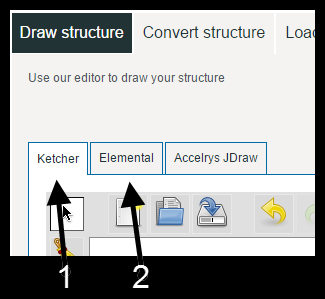
Structure editor
(structure search page, etc.)
Click on the tab for Ketcher (
1
) or Elemental (
2
)
Spectra
Select the top radio button (
JSpecView
)
3D structure
or
Crystal CIFs
Select the top radio button (
JSmol
)
I don’t have Flash. Can I still use the site?
Absolutely. Most of the functionality on ChemSpider works perfectly without Flash, with the possible exception of some embedded videos.
Can I reuse the ChemSpider data? How do I cite a ChemSpider record?
All data displayed onscreen can be reused in a publication or for other purposes. You can cite a ChemSpider compound record using the permalink based on the ChemSpider ID, e.g.
http://www.chemspider.com/Chemical-Structure.1906.html
. Due to the dynamic nature of ChemSpider (data is being added and curated all the time) it is often advisable to also include the date on which the data was accessed on ChemSpider. If you click “More details” on the record page, it will provide all the information needed to cite the record.
Can I export a structure to X program? Can I download a chemical structure as a Y file?
You can save individual structure files in .mol format by clicking the save button underneath the picture of the structure – this is the button with the floppy disc. Mol files can be read by all major chemical drawing packages. If you are registered as a user, you can also save searches as SDF files by clicking the “Download” button on the search page.
I’ve found an error in a ChemSpider record, what should I do?
At the very least, please let us know by adding a comment. At the top right of the page, please click the
Comment
button and complete the details. The comments will be reviewed by another curator and we’ll update the record where appropriate.
If you are a registered user and have Curator privileges, you can
Reject or Confirm synonyms
. This marks them for deletion or validation.
Please note that users cannot reject validated synonyms. If you see a name which you believe has been incorrectly validated, please leave feedback on the page.
Why should I comment on bad data?
It’ll help your next search, and the searches of others. Comments and amendments will be reviewed by other curators as a check, but we need the knowledge and expertise of our users to clean up and validate errors. We perform many automated checks and validations when we load compound data into ChemSpider, but there are many errors and inconsistencies in the public chemistry data sets – for some examples of these, see Antony Williams’
presentations
about ChemSpider.
I have found a name or identifier in a record which I believe is incorrect for this record. Why is this?
ChemSpider is an aggregator of information from many different resources. In some cases the data that is supplied by a datasource contains errors. This is why we have a system of curation that allows users to flag, contribute and alter data. It is also why we employ different formatting for names: this allows us to separate synonyms and identifiers that have not been verified against a record (in normal type) with those that have been validated indicated by Bold type.
If you have found a name which you believe is incorrect, please leave us feedback so we can review the data. Where possible, please provide a link to a supporting source for the information, so we can make an informed decision about how to curate the record.
The molecular formula doesn’t agree with the structure. Why is this?
We calculate the molecular formula directly from the structure, so the molecular formula and structure should almost always be in agreement. In many cases, the apparent discrepancy is because the structures on ChemSpider are drawn as
skeletal formulae
(also known as line-angle notation). If you do not know what a skeletal formula is, please read the answer to the
next question
.
Occasionally, even counting the implicit hydrogens and carbons, the structure will still appear to disagree with the molecular formula. This usually happens because the structure overlaps with itself, hiding part of the structure. More rarely, this may be caused by a bug in the molecular formula algorithm. If after checking the implicit hydrogens and carbons you still find the molecular formula and structure do not match, please leave feedback. This way we can take a closer look, and can try to resolve any issues.
What is a skeletal formula?
Skeletal formulae
are a standard, short-hand way organic chemists draw molecules. In this type of structure drawing, bonds are drawn as lines. Each corner or intersection represents a carbon. Each carbon atom is assumed to be bonded to enough hydrogens to have a valency of 4. Let’s take a look at the ChemSpider structure for
ethyl acetate
(
C
4
H
8
O
2
):
If we assume that each corner or intersection is a carbon atom, and each carbon atom has enough hydrogens to have a valence of 4, then we can expand the structure to the following:
Counting up the hydrogens and carbons gives you a molecular formula of
C
4
H
8
O
2
.
Can I download the complete data set?
You can assemble a database of 5000 structures or less, and their associated properties, from our database without our permission. You can download up to 1000 structures per day from the website. If you want to do more than this, please contact us for help – we don’t make the entire set available for free download. Don’t forget we also have an extensive set of web services to connect to the ChemSpider database.
I’d like to scrape content from ChemSpider, can I do that?
We do not allow the scraping of ChemSpider pages for a number of reasons, primarily because scraping places undue strain on our systems and reduces the responsiveness and functionality of the site for everybody else. In addition, some data is kindly made available by third parties who are happy to permit users to access and make use of data on an individual basis but do not allow us to make large sets of data available. If a few users seek to scrape this content it may be that we will be required to remove some data to the detriment of all users.
How are the page titles chosen?
Most of the page titles on ChemSpider are chosen automatically, from the list of Approved synonyms- based on a number of criteria. This approach selects the best name in a high percentage of cases. If you believe that the title name on a page is in error, please
leave a comment
on the page.
What is an Approved Synonym?
On ChemSpider, we have tiered levels of confidence for synonyms on each record. Those which are in
bold
are approved synonyms, which means that one of our members of staff or more experienced volunteer curators have checked that the synonym is correctly associated with the structure at the top of the page. Please note this does not mean the synonym is an official or standardised name, just that we have checked that it is correctly associated with the record. More information about this can be found on our
Curating Identifiers
help page.
Advertisement
Advertisement
Spotlight
Advertisement